Tuesday, April 30, 2013

Bill and Barbara Parker, Chapman University's Biggest Fans


http://www.thepantheronline.com/sports/alumni-couple-is-chapmans-biggest-fan

By Vaughan Ryan, Staff Writer
Published 29 April 2013


With season tickets, they attend almost every school sporting event, match and meet. Parents and players know them by name and always greet them on the sidelines. They’re arguably Chapman’s most avid athletic fans – and have been for nearly 60 years.
Bill Parker, 85, and Barbara Parker, 83, graduated from Chapman College, as it was formerly known, in 1952 an++d 1964. But the couple never strayed far from its alma mater. The Parkers support Chapman’s 19 athletic teams simply because they value the relationships created with athletes over the years.
“We connect with the athletes more than anyone,” Bill Parker said. “We just share a love for competition and the relationships built when being part of a team.”
The pair grew up in California and met at a church conference in 1949. Bill’s older sister, a 1943 Chapman graduate, introduced him to the campus and he committed to Chapman soon after. Barbara also made the move after a year at El Camino Community College.
A small private school at the time, Chapman College had just three sports. The baseball, basketball and track and field teams were stacked with the same nine students, including Bill.
“When we had a game, all nine guys had to be there or there was no game,” Bill Parker said.
The Parkers had two children while at Chapman and had their third son following Bill’s graduation. Their fervor for athletics soon leaked into their parenting, as they enrolled all three children in football and basketball at an early age.
While die-hard sports fans, both Bill and Barbara are also interested in students that aren’t athletes, eldest son Bob Parker said.
”Though they religiously follow the sports, they truly care about all of the students,” Bob Parker said.
Bob didn’t attend Chapman, but witnessed his parents’ enthusiasm for teaching young athletes life lessons off the playing field.
“They’re proud to keep the athletes and students educated and always know everything happening at Chapman,” Bob Parker said.
Graduation didn’t stop the Parker’s attendance to the Panthers’ sporting events or their dedication to improve their alma mater. Bill and Barbara each played a leading role in the 2012 launching of the Chapman Alumni Lifelong Learning program, which allows alumni over 50 years old to audit classes for free.
Freshman Samara Hanna, a dual-sport athlete in volleyball and basketball, has already felt the Parker’s presence in just one year at Chapman.
“I’ve never met people that love life and love this school so much,” Hanna said.
The pair has watched Chapman expand as students and athletes come and go, but that isn’t the end of the road for the Parker’s relationships. Bill is writing a letter to his grandchildren with a list of more than 200 relationships. He not only remembers athletes’ names, but also the lessons he’s learned from them. His grandchildren will open the letter when he passes away.
And the Parkers don’t plan on leaving campus after their passing either. Bill and Barbara have each reserved a space at the Chapman Columbarium in the Fish Interfaith Center. The Columbarium, a large marble wall, will hold the Parker’s ashes and forever sport their names chiseled into the marble.
“We’ll be involved and go to games as long as we can function. We’ve been here so long and the Columbarium will let us be here forever,” Barbara Parker said.
Bill echoed his wife’s emotions and their increasing ties to Chapman’s athletes.
“Chapman is more than a home for us. We identified with the sports from the time they started here and they’ll always have our support,” Bill Parker said.

Sunday, October 07, 2012

William Taptico, Last King of the Wicocomico


When John Smith explored Virginia in 1608, he encountered a village with 130 men on the South side of the mouth of the Patawomeke (Potomac) River. These were the Wicocomico people.

English settlers arrived later, and began interacting with the local tribes. Sometime between 1652 and 1655, the Northumberland County Court directed the Wicocomico and Chicacoan tribes to merge, and the new tribe was given 50 acres per fighting man, for a total of 4,400 acres near Dividing Creek.

The Lower Cuttatawomen later merged with the tribe, which was called the Wicocomico since most of the tribe members were originally from that group. Machywap, formerly the king of the Chicacoan, was appointed by the court to be the leader of the tribe, because he was considered a friend of the English and easy to manage. By 1659, Machywap had been deposed, possibly by force, and replaced with a man named Pekwem.

The Wicocomico and the English settlers fought often in court for control of the local lands. Although most of the disputes were settled in favor of the Wicocomico, by 1719 the tribe held only 1,700 acres of their original reservation. In 1705, Robert Beverley, Jr. wrote "In Northumberland, Wiccocomico, has but three men living, which yet keep up their Kingdom, and retain their Fashion; they live by themselves, separate from all other Indians, and from the English."

The last king of the Wicocomico was named William Taptico II.  When he died in 1719, the English took over the lands of the Wicocomico and left the tribe dispersed. William Taptico's wife, Elizabeth, settled his substantial estate and began by signing the documents as Elizabeth Taptico, but by the end shortened the name to Elizabeth Tapp. (It is not clear whether Elizabeth was of European or Native American descent.)

William Taptico II was my 8th great grandfather. Some believe that William's grandfather was Machywap.


Alexander Kesterson Mark

Alexander K. Mark, a widely known and highly esteemed Oregon pioneer of 1847, and one of the most prosperous farmers in the State, comes of a family who, from the time of the grandparents, were born in the state of Kentucky: it is believed that they were of Irish descent, whose ancestors settled in the colonies at an early day. Grandfather Samuel Mark was one of Kentucky’s earliest settlers while his son, John Mark, father of the subject of our sketch, was born and reared and afterward married there, to Miss Fanny Forester, also a native of the State. They had six children, five of whom survive.

The subject of our sketch was born in Kentucky, December 28, 1822, and resided in his native State, until his sixteenth year. He then removed to Missouri, where he remained until he attained the age of twenty-five years, when, following the example of other adventurous spirits, he crossed the plains for Oregon. Making the long journey with oxen, he arrived in Oregon City on October 12, 1847. He at once took a donation claim of 820 acres, situated thirteen miles south of the latter city, in Clackamas county. On this, he built a cheap, frame, house, and for four years lived and worked alone.

At the end of this time, he married Miss Sarah Jordan, an estimable lady, and also a native of Kentucky. She came to Oregon in 1853, when he became acquainted with her, and married her in January, 1854.

He continued to reside on his farm, where he had lived since 1848, until 1870, doing all the hard work and enduring the hardships incident to pioneer life, but by hardy industry, surmounted all obstacles, and became one of the most successful farmers of his county.

He and his wife had three children, two daughters and one son: Marinda, the oldest, is now the wife of Richard Caldwell, and resides in Dayton, Washington; Martha Jane, is the wife of Sena Chapman, residing in Washington; while William, who is also married, resides in California and attends a Methodist Episcopal Theological school. The devoted wife and mother, died in 1859, but six years after her marriage, having many friends, to mourn her loss. She was a woman of superior intelligence, and a charming character, and was esteemed by all who knew her. On December 27, 1871, Mr. Mark married Mrs. Mary S. F. Sparks, the widow of Nathan Mitchell Spars, and daughter of Dr. Hill, of Albany, who came to Oregon in 1853.

She had five children by her first marriage: Emily Lenore, now the wife of William M. Gregory, resides in Portland; Martha R., died, aged three years; Elijah H. resides in Princeville; Margaret Ellen, is the wife of J.F. Hill, of Portland; Nathan B., is the youngest.

Mr. and Mrs. Mark have three children: Addie Mable G., Jewell Ester, and John Coleman.

In 1888 Mr. Mark removed to McMinnville, to secure for his children, the benefit of a superior education at the college in that city. He purchased property in a desirable locality, and built a pleasant home, which was afterward consumed by fire. He has however, replaced it with even a better structure, which is suggestive of comfort and taste, and which is surrounded by attractive grounds. One of the children have graduated from the Academic department of the college, while the other two are still pursuing their studies, in that institution. 

He has owned and sold different property, but retains his donation claim, on which there is now a good district school, for which he gave the site.

Originally a Democrat, at the time of the war, he became a strong Union man, and has since affiliated with the Republican party. He is much interested in the cause of temperance, having always abhorred the liquor traffic.

Mr. Mark has been a Methodist for fifty years, and has often been a Steward of the Church.

His life would be a good example for any young man, to follow. Sober and industrious, persevering always in the direction which his better judgment dictated, he has, by his own efforts, carved out a competency from the new but intrinsically great commonwealth of Oregon, and no one of her citizens, of whom she boasts the proudest on the face of the earth, can excel him in all goodness and worth.

Source: "An Illustrated History of the State of Oregon - Pen Pictures From the Garden of the World", published by The Lewis Publishing Company, Chicago, 1893

Wednesday, October 12, 2011

Elbert Pinney's Application for Presidential Pardon

Elbert Pinney, my 4th great grandfather, was the son of Henry Pinney.  He lived an amazing life.  During the Civil War, he fought on the side of the Confederates.  After the war, he wrote a letter requesting a presidential pardon, and asked others to write letters on his behalf.  His in-laws in Illinois, the Youngs, were apparently "radical" Republicans (see the last letter). Must be genetic! Here is the text from those records:


Elbert
Dr. Pinney
Pardon. Tex.
Mr. Washburne of Illinois…[illegible] Pardoned Dec 8th 65


To His Excellency Andrew Johnson President of the United States of America

Your Petitioner Elbert Pinney a Citizen of the County of Hunt and State of Texas would Humbly represent unto Your Excellency, that he was a Surgeon in the 1st Chickasaw Battallion engaged in the Service of the so-called “Confederate States of America” in rebellion against the Government of the United States of America.

That he entered said service in the month of January 1862 and resigned the said position of surgeon in said Battallion in the month of July following and returned home

That in the month of July 1863 he was drafted into the state militia of the State of Texas and was elected 1st Lieutenant of Company “E” 2nd Reg. Texas State Cavalry. That he remained in that position six months. That in the month of March 1864 he was appointed surgeon of the 1st Battallion Texas Cavalry and served in that capacity until the Close of the Rebellion

Your Petitioner would represent unto Your Excellency that he is 40 Years of Age, by Profession a Physician. That he was born in the State of Connecticut, that from there he removed to the State of Pennsylvania about the year 1828 and from there he removed to the State of Illinois about the year 1847. That in the year 1856 he removed to the County of Hunt and State of Texas and has resided in said last mentioned County and State ever since, That he held the office of Assistant Post Master at “Tidwell Creek” in said county and state from sometime in the year 1859 till the Breaking out of the Rebellion, and held it under the government of the so called Confederate States untill the repression of the Rebellion

That upon the close of the Rebellion your petitioner appeared before Hardin Hart Chief Justice of Hunt County State of Texas and took the Oath of Allegiance prescribed by the proclamation of the President of the United States which said Oath of Allegiance is hereunto attached. That he has returned heartily to his Allegiance to the Government of the United States and is desirous of being a truly loyal citizen thereof. And for his participation in the said Rebellion he prays that your Excellency will grant him a Special Pardon and as in duty bound he will ever Pray


Subscribed and sworn to before me this Ninth day of October AD 1865
Wm. Lane Notary Public (signed)


We the undersigned would respectfully represent that we are acquainted with Doctor Elbert Pinney and believe that he is really desirous of becoming a truly loyal citizen and that if the prayer of his Petition is granted that he will heartily support the Government of the United States and use his influence in restoring its authority in the section where he resides

A.G. Jackson (signed)
Wm Lane (Signed)


Whiteside County, Illinois.
Treasurer’s Office.
Morrison, Oct 26 1865.
Hon E.B. Washburne
Galina Ill

Sir- Application is being made for a Special Pardon in the case of Dr Elbert Pinney who was connected with the Rebellion. I am not acquainted with Mr Pinney, but from the character of the persons endorsing his petition for pardon I have no doubt that it should be granted. His family connections in this county are among the most influential Republicans of the County and have been active supporters of the policy of the Government throughout the war. Any favor extended will be kindly remembered

Yours truly
Ed B Warner (signed)


Chicago Oct 21st 1865
Hon E.B. Washburne
Galena

My Dear Sir
A large number of your political as well as personal friends, residing in Union Grove Whiteside County are much interested in a Special Pardon for Dr Elbert Pinney who has been in some way identified with the Rebellion. I know nothing about the Dr but I do know his relations in Whiteside (and especially your old friend D. B. Young of Union Grove who is the Dr’s father in law) are among the most influential (Radical if the administration will allow the word) Republicans in Your district. Any favor you can do the Dr. or his friends will be appreciated by your humble servants

Yours Truly
L. H. Robinson


Henry Pinney's Application for Presidential Pardon

Henry Pinney was my 5th great grandfather. He was born in December 1799 in Litchfield, Connecticut, to Grove Pinney and Mercy Case. On January 12, 1825, he married Delina Riggs. They had two children, Elbert and Adeline. He later moved to Texas, where he died in 1872.  He was the postmaster in Tidwell Creek, Hunt County, Texas when the Civil War broke out.  I recently came across his petition for presidential pardon.  Here's the text:


Hunt County
Henry Pinney
Petition for Special Pardon
1st Exception, Postmaster
Executive Office
Austin Texas
March 29th 1866
I respectfully recommend the Pardon prayed for in the within petition.
A J Hamilton (signed)
Provl Gov of Texas
April 11th 66


THE STATE OF TEXAS
COUNTY OF HUNT.

Personally before me, Hardin Hunt, Chief Justice of Hunt County, appeared Henry Pinney, a citizen of said county, who in my presence took and subscribed the following oath:

I do solemnly swear, in the presence of Almighty God, that I will hereafter faithfully defend the Constitution of the United States, and the Union of the States thereunder, and that I will in like manner abide by and faithfully support all laws and proclamations which have been made during the existing rebellion, with reference to the emancipation of slaves. So help me God.

Henry Pinney (signed)

To certify which I have hereunto set my hand and affixed the seal of my office, at Greenvile, this 30th day of October A.D. 1865.

Hardin Hunt (signed)
Chief Justice of Hunt County


State of Texas
County of Hunt

This certifies that H. Pinney has this day taken the oath of amnesty as a preliminary step for making application to the President of the United States for special pardon as prescribed by the President of the United States in Proclamation of May 29th 1865

Witness my hand and the Seal of the County Court this 30th day of October AD 1865

Hardin Hunt (signed)
Chief Justice of H. Co. Texas

Attest
A Cameron (signed)
[illegible] Texas


The State of Texas
County of Hunt

To his Excellency Andrew Johnson, President of the United States of North America.

Your Petitioner, Henry Pinney, a citizen of the County Hunt and State of Texas, would respectfully represent unto your Excellency that as early as the Spring of A.D. 1857, he was duly appointed Postmaster at Tidwell Creek in Said County of Hunt, and held said office under the Authority of the Government of the United States, until sometime in the Summer of A.D. 1861 when, without Solicitation on his part, he received from the so called Confederate States Government the appointment of Postmaster for the said office at Tidwell Creek. Petitioner further alledges that he accepted said appointment and held said office, under the authority of the So Called Confederate States Government during its continuance. That said office is a small county office, the annual income of which does not Exceed the Sum of Fifteen dollars.

Petitioner further Says that in accepting said office, from the So Called Confederate Government or in holding the Same under the authority of the Said Government he had not the least thought or intention of committing treason against the Government of the United States but that his sole object was to accommodate his neighbors & the community in which he resided with mail facilities near home.

Your petitioner would further state that he is now Sixty Five Years old, that he did not engage in the late rebellion in any way, except to hold the office of Post Master, as aforesaid. And that he has no property, money or means of Support.

Your Petitioner would most respectfully pray, the promised considered, that your Excellency would grant to him Special Pardon, and that he may be restored to the privileges, immunities and rights of citizenship in the Government of the United States of America, and as in duty bound petitioner will ever pray.


Sworn to and Subscribed before In Testimony whereof I have hereunto set my hand and seal of the County Court hereon impressed at Office in Greenville on the 14th day of November 1865
A Harrison Clerk County Court Hunt Co Texas (signed)


Sunday, June 26, 2011

Joseph Milus Stevenson

Catherine Cox and her first husband, Agrippa Parker, had three children together: John, James and Cynthia. Agrippa died at about age 30, probably around 1846. Catherine then married Joseph Milus Stevenson, a widower with four children of his own.

Together, Catherine and Joseph had many more children.  (Catherine later raised her daughter Cynthia's children also.)

So Joseph Stevenson was my great-great grandfather's (James Parker's) stepfather.  Joseph was a well-educated man who served a term as a Missouri State Senator in 1835-1837. During the Civil War, Joseph enlisted on January 25, 1862 at Middlebrook, Iron County, Missouri in Company B, 12th Missouri State Militia, led by Captain William J. Leeper.  He was 62 years old. Joseph's sons, Robert, Henry and Joseph, as well as his stepsons John and James Parker, also fought for the Union.

In July 1862, Joseph was sleeping in a tent near Greenville, Missouri, not far from Iron County, when the Confederates made a night raid on the Union camp.  Joseph was shot in the head as he slept and lived for two days. His nephew, Henry H. Stevenson, was fighting for the Confederates and was captured during the raid. Henry nursed his uncle until he died.

Joseph is buried in the National Cemetery at Jefferson Barracks, Missouri, in a grave with a marker that only says J.M.S.

Wednesday, July 14, 2010

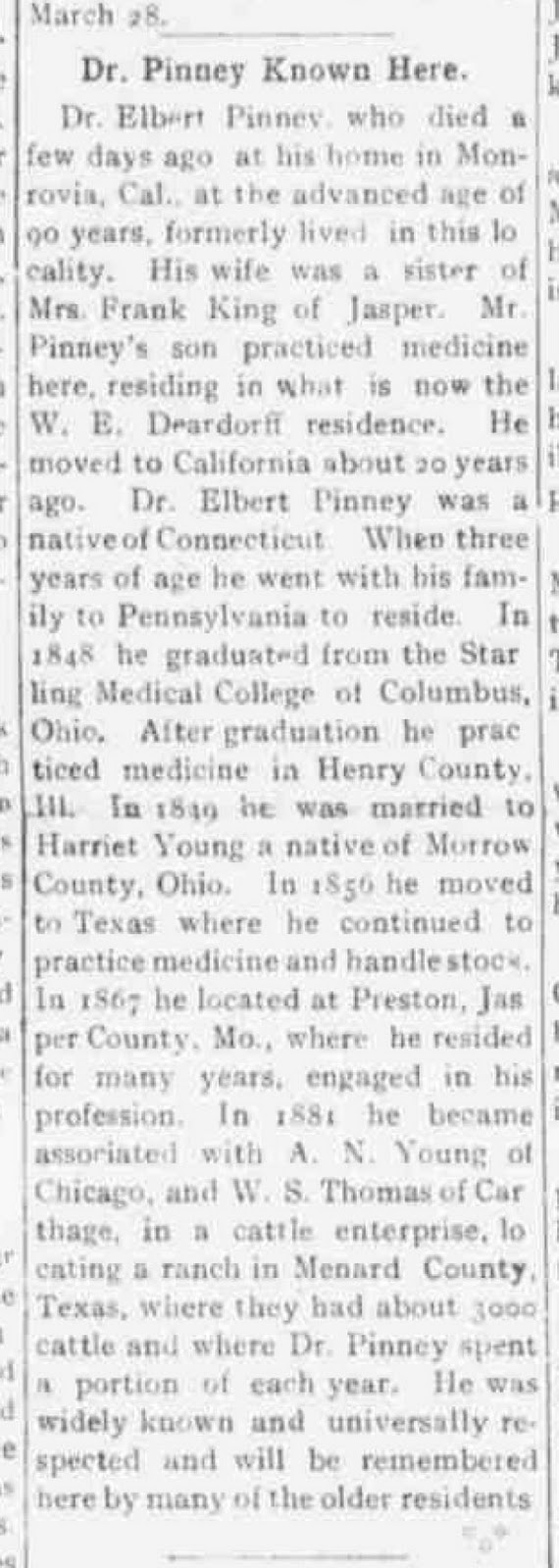
Dr. Pinney Known (in Jasper)

From the Jasper News (Jasper, Missouri), April 2, 1914. (Click for larger.)

Sunday, July 11, 2010

Charles Thomas Smith (1874-1933)


I found a lot of new information about Charles T. Smith yesterday. Previously, we knew very little about him. We knew he was Percy's older brother, and that he was born on July 5, 1874 in Maidenhead, Berkshire, England. We knew that all of his siblings except for Frederic had immigrated to America.

So I was surprised when I found this:


This is a WWI draft card, filled out in September 1918 by a Charles Thomas Smith who was living in Hopland, Mendocino, California.  His birthday? July 5, 1874! Born in England! Could this be our Charles?  His occupation is listed as "farmer" and his wife is listed as "Gertrude Smith."  He is described as having blue eyes and light hair. With these clues, I did some more searching and found this:


This is the 1920 census record that lists Charles Smith and his family.  He was living in Mendocino, California at the time and working as a sheep farmer. His date of immigration to the United States is listed as 1916.  Also listed are his wife (Gertrude) and children: Gertrude, Charles and Ernest, along with all of their years of birth.  Charles' wife Gertrude is listed as having been born in Germany (!), as are Gertrude the daughter and the oldest son Charles. Ernest, on the other hand, is listed as having been born in England in about 1915. Also living with the Smith family in Mendocino at the time were Anna Fraser, a cook, and Henry Vassar, a farm hand.  With that information in hand, I found this:


This is the passenger manifest for the Adriatic, which sailed from England and arrived in New York on May 11, 1916 carrying Charles T. Smith and his family.  From this document, I learned more about the specific cities of birth, and was able to confirm that this was indeed our Charles--he is listed as having been born in Maidenhead.  Also, the document (on the second page, not shown here) lists their final destination as Long Beach, California. It says Charles had visited California previously, in 1914. The document also says they were heading to Long Beach to meet up with Charles' brother, L. H. Smith, who at the time was living at 255 Wisconsin Avenue, Long Beach, California.  At the time, Charles is listed as being 5' 8.5", with a "fresh" complexion, brown hair and gray eyes.  For a distinguishing mark, he had damaged sinew on his right hand from an accident with a "small fryer." Also interesting to note: his wife, Gertrude, had a mole on each side of her nose (I love the descriptions on these old documents). On the Adriatic, they traveled with a 26-year old photographer from Formby, England, named Lucy Reynolds. Charles paid her fare of passage, and she was also headed to Long Beach.

Here's another interesting ship manifest I found, from a 1920 trip that Charles and his family took from England back to the United States aboard the "New York":


On the second sheet of this manifest, Charles is listed as having red hair and being 5' 10".  They were still British citizens at the time.  While in England, the closest relative or friend whom they visited was a "Mrs. I. Craig" who lived at 142, Dora Road, Wimbledon Park, London.  They were returning to the "Fountain Ranch" in Hopland, Mendocino, California, where Charles was a sheep farmer.  The ship left Southampton on August 7, 1920 and arrived in New York on August 18, 1920.

Charles and his family show up in the 1930 census, still living in Mendocino, California. From this census we learn that Gertrude's native language was German:


Charles is listed by other researchers in Ancestry.com as having died in Long Beach, California on January 8, 1933, but I cannot find any documents online to back that up (yet).  Piecing together information from other sources (including familysearch.org--some of Charles' descendants are LDS), I found the following information about Charles' family:

Wife:

Gertrude Helene Louise Abraham, was born in Pösen, Saale-Holzland-Kreis, Thüringen, Germany on September 5, 1878. She died in 1959 in Vacaville, California (not documented). 


Children:


Gertrude Louise T. Smith was born on March 13, 1911 in Berlin, Germany. She may have died on June 8, 2004 in Fresno, California. I have not found any information regarding a spouse or children for Gertrude.


Charles Julius Thomas Smith was born on February 22, 1913 in Hamburg, Germany. He died on September 9, 1995 in Pollock Pines, El Dorado, California.  I have not found any information regarding a spouse or children for Charles.


Ernest Gordon Smith was born on January 8, 1915 in Brockenhurst, England.  He married Gwynneth Eleanor Jones in Chesterfield, Derbyshire, England in early 1943. They had at least two children: Margaret Elaine Smith (born in 1946) and Christopher Paul Smith (born in 1948 in California and died in 1989 in Arizona). Ernest died on April 12, 1998 in Show Low, Arizona. 


Do you have any more information about Charles and his family?  If so, tell us in the comments!

Thursday, May 27, 2010

Funeral services for Bessie Losee Smith

From the Long Beach Independent, February 1946:

Percy Smith, Dean of the Long Beach Realtors

From the Long Beach Independent, Wednesday, May 3, 1950:

Tuesday, May 11, 2010

Dr. Elbert Pinney (1826-1914)


Elbert Pinney is my great-great-great-great grandfather. Here's an interesting biography I found of him, written in 1876:

He was born in New England of a family of Scottish descent. The first members of the Pinney family to make their homes in America, were three brothers who emigrated from Scotland, and settled in New England at a date long previous to the revolutionary war. In the war of the revolution, Dr. Pinney’s grandfather took part; fighting on the side of the colonies.
He was the oldest of two children of Henry and Delina Pinney, and was born in the town of Coldbrook, Litchfield county, Connecticut, on the 29th of January, 1826. His mother’s maiden name was Riggs. When the son was three years old his father removed with the family from Connecticut to Erie county, Pennsylvania, remaining in that county about twelve years, and then removing to Crawford county in the same state. The Dr. received a substantial common school education, at an early age determined to become a physician, and at eighteen began his preparatory medical studies at Meadville, Crawford county, Pennsylvania, in the office of Dr. William Woodruff, one of the leading physicians of that town. He afterward attended medical lectures at the Starling Medical College at Columbus, Ohio, from which institution he graduated on the 22d of February, 1848.
In the summer of 1847, previous to his graduation, he removed to Henry county, Illinois, returning to Columbus, Ohio, to complete his medical education the succeeding winter. Immediately after receiving his degree he established himself in the practice of medicine in Henry county, Illinois, at the town of Wethersfield, and succeeded in building up a fine medical practice. He refers with pride to many of his former friends at this place, among them the Messrs. Potters and Blishes, and to Dr. Thomas Hall, in every respect one of nature’s noblemen. March 29th, 1849, he was united in marriage to Harriet Young. Mrs. Pinney was born at Mt. Gilead, Morrow county, Ohio. The father was D. B. Young, who emigrated from Ohio to Whiteside county, Illinois, in the fall of 1837, and was one of the early settlers of that section of country.
Dr. Pinney practiced medicine in Illinois till the fall of 1856, and then on account of ill health moved to Texas, and again established himself as a physician at White Rock, in Hunt county, obtaining a fair share of the medical practice in that locality, and in addition interesting himself in various business enterprises. He raised stock to a considerable extent, and his business prospects for the future were the most promising, when “the late unpleasantness” opened in the spring of 1861.
Believing that the several states composing the Union were sovereign in all things that related to themselves, and trusting that those principles were “foreordained,” and “predestined” to ultimately prevail, in January, 1862, he joined the Confederate army, and was assigned to duty in the medical department of said army, and was actively employed in the Confederate medical service from that time, onward to the close of the war. He served in the Indian Nation and in Texas, and was moved from point to point according to the exigencies of the occasion, and as his services were called most in requisition. He was on staff duty in Col. Town’s Texas brigade, and
during the last two years of the war was stationed on the Gulf Coast, near the mouth of the Brazos river.
The conclusion of the war, found his circumstances and prospects less brilliant than before the inauguration of the contest. He lost a considerable proportion of his property. Society was in an unsettled condition, and property insecure throughout Texas, and believing it would take several years for the country to recuperate and recover its former stable prosperity, he resolved to remove to Missouri, and in the summer of 1867 located at Preston. In Jasper county, where his residence has since been. He has secured a large medical practice extending over a wide scope of country; and farming and stock raising have also occupied his attention. Dr. and Mrs. Pinney have eight children. The oldest, Henry B. Pinney, is established in the practice of medicine at Joplin, Missouri, having adopted the profession of his father. The next son, John L. Pinney, is in the stock business in this country. The oldest daughter is the wife of O. W. Rose. The other children in the order of their births are Nettie, Lulu, Charity, Joel and Elbert. Since his residence at Preston, Dr. Pinney has won the regard of many of the citizens of the county. He has attended strictly to his professional business, and at the same time has been anxious to discharge every duty as a public-spirited citizen, and a good old line democrat. His large and laborious practice has closely occupied his time, but with a desire to oblige and accommodate, he has held himself ready “in season and out of season” to give his services to his patients irrespective of his own comfort or convenience.
Source: Biographical Sketches of Citizens of Jasper County, Missouri. 1876 Jasper County Historical Atlas. Published by Brink, McDonough & Co.
It's interesting to note that while in Texas, Elbert "owned" five slaves: a 35 year old male, a 28 year old male, a 20 year old female, a 4 year old female and a 2 year old male. I found Elbert in the Slave Schedules of the 1860 Federal Census. After the Civil War, he moved to a large farm in Preston, Missouri. One of his slaves, with his family, followed Elbert soon after, and apparently remained "devotedly attached to him up until the time of his death." (Source: History of Monrovia, Chapter VIII.)

While in Southwest Missouri, Elbert became a bank president and successful farmer while still practicing medicine.
In 1887, the Pinneys moved to California. In August of that year, they arrived in the new town of Sierra Madre. Elbert bought 35 acres of land at the base of the San Gabriel Mountains. His tract sloped gently from the base of Mt. Wilson with views towards Los Angeles fifteen miles away.
Elbert hired renowned architects Samuel and Joseph Cather Newsom to design a new hotel. The Newsom brothers created a dramatic Queen Anne style hotel with its signature oriel tower and sweeping front veranda. The Sierra Vista Hotel opened with 20 comfortable rooms.
The Hotel was "A quiet and comfortable home for sojourners and tourists. The Building and Furnishing Entirely New. Reached by carriages from station on the Santa Fe railroad one mile distant. There is from this House a fine view of the beautiful San Gabriel Valley, extending from on end of the valley to the other and from the mountains to the sea, presenting a picture grand, inspiring and never tiring, revealing to the observer new beauties each day. The comfort of their Guests is the First Care of the Managers of this House. Fare and Accommodations as Good as can be had anywhere. Board with Room $8 to $12 per week."(Valley Vista newspaper July 31, 1889.)
Throughout its 115 year life the Hotel that Elbert built has been one of the treasures of Sierra Madre. A few years ago Ginger and I went there and took pictures, which I can't find at the moment. But there are plenty of photos online. Here's one:

Many films and commercials have used the Pinney House over the years. Notable films to add to your Netflix list include:
  • The Seven Little Foys - Bob Hope, 1955
  • Great Man's Lady - Barbara Stanwick and Joel McRae, 1941
In 1887, the same year the Pinneys arrived in California, one thousand acres of the Maclay Rancho Water Company lands were sold to Jouett Allen, Elbert's son in law. Jouett was a lawyer and real estate developer from Chattanooga, Tennessee. Jouett divided up the land and transferred 100 acres each to Elbert, R. A. Hoyt, R. A. Hoyt, Jr., "Mrs. E. M. Rose" (my great-great-great grandmother Emily Pinney Rose), and a Mrs. Durbin. The group laid out a new town site and named it Pacoima, an Indian word meaning running water. (The adjoining canyon was already named Pacoima.) An active sales campaign was inaugurated with the price of lots on the main streets running from $500 up, and from $1 to $20 in the outer sections. Grading of the streets and construction soon made it a very busy place.
While living in California, Elbert was famous for his skill as a doctor, and apparently gave "scientific attention to the raising of oranges and made a business success of it." I don't know where he found the time. Seriously. Between running a hotel, developing property, healing patients, and founding a city, how did he also run a successful orange orchard? He must have been quite a guy.
He died on March 17, 1914.
Here's a photo of the Elbert Pinney family portrait that Grammy and Grampy have hanging on their wall:

(I believe Emily May Pinney Rose is in the back row, second from the left.)

Friday, May 07, 2010

Cheslia Reese Parker's WWI Draft Card

Cheslia was born on September 18, 1894 in Chico, California. When he filled out his WWI draft card, he was:
He ended up serving in the 51st Balloon Company, US Army, during WWI.

Wednesday, May 05, 2010

Caty Cox

After Caty's first husband, Agrippa Parker, died in 1846, she married a man named Joseph Milus Stevenson. Joseph was 22 years older than Caty, and already had four children by his first wife.

He died in the Civil War near Greenville, Missouri in July 1862--at the age of 62. He was buried on the battlefield, leaving Caty to raise their six children.

Not long after, her son James turned old enough to enlist.

In total, Caty helped raise 13 children (9 of which were her own), and at least 3 grandchildren.

Cynthia Ann Parker

James R Parker had a younger sister named Cynthia Ann. She was born in Washington County, Missouri on October 28, 1844. When she was 19 years old, she married John Amsden, a blacksmith. They had three children together: Sarah Jane, Frederick, and Isabelle.

Unfortunately, when Cynthia was only 30 years old, she fell from a haywagon and was killed. She is buried at Brewington Cemetery near Brunot, Wayne County, Missouri. Her mother, Catherine "Caty" Cox Parker Stevenson, raised the three children. Cynthia's husband, a veteran of the Union Army, later remarried and moved to Reynolds County where he worked as the postmaster in Centerville from 1903 until 1912. He was an immigrant from Tring, England (near London) in 1858.

Saturday, May 01, 2010

James R Parker


James Parker was born in Missouri on October 11, 1846. He was the son of Agrippa Parker and Caty Cox. The Parkers and the Reeses were both early Wayne-Madison County Missouri families.

During the Civil War, James enlisted in Co. L, 3rd Missouri States Militia Calvary. On October 4, 1864 he transferred to Co. B, 2nd Battalion, 19th Regiment, Cape Girardeau, Missouri. He was discharged on October 4, 1867 at Camden, Arkansas. James received a pension for his service.

In 1871, he met and married Mary Ellen Reese in Iron County, Missouri.

In 1880, the family was living in Union Township, Iron County, Missouri, next to James' mother, Catherine Cox Parker Stevenson. The family moved to California in about October 1881 living near the family of Joseph Alexander Stevenson, James' half-brother. A group of relatives from Iron/Wayne County all made the move to Butte County, California, together.

The first Parker home in Butte County was a one room California style house located in the foothills on the west slope of the Sierra Nevada mountain range, about 15 miles northeast of Chico, California. this house was located on a small stream in Hog Hollow. The land located in this little valley was rocky and not very productive. The Parker family, composed of father, mother and three children, arrived by train from the Ozark Mountains of southeast Missouri. The small house erected to house the small family had a rock fireplace. There were oak trees near the house. The family raised hogs, chickens and turkeys and worked for the nearby farmers. In the two or three years that the family lived at this location, work was scarce and the times were hard.

In 1883, James secured employment from General John Bidwell at the Gee(?) Ranch and moved the family to the ranch. The family lived in a good house and the children of school age attended the Chico Schools. Chico was only a few miles away. George was born there.

About 1886, James filed on a 160 acre homestead located about 9 miles southeast of Chico, just east of the stage road from chico to Oroville. He built a two story home and a barn on the land. They farmed the place and made a good living for the family there. William, Cheslia, Gertrude, and Theodosia were born there. The children were educated at the Stoneman School located about 7 miles away. Later, they attended Chico Normal School, which became Chico State.

General Bidwell named the train station in Magalia "Parker Station" after James Parker. It does not exist any longer.

In about 1909, James and Mary moved to Bakersfield. James passed away in 1911. He and Mary are buried at Paradise, Butte County, California. They had 10 children together.

Here's the record of James' enlistment in the Union Army:


Here's a copy of the marriage record for James and Mary:


UPDATE (5/25/10): Added the photo of James at the top (taken in 1864 when he was discharged from the Union Army), and his discharge papers, below:

UPDATE II (5/25/10): There is some confusion about James' middle name. For this post we've decided to leave it as James "R" Parker. In different family trees he is listed as James Roland or James Reese. Some even have it recorded as James Richard. The Parkers and Reeses were both early Wayne-Madison Co Missouri families. James eventually married a Reese, so the families may have been close and it is possible his middle name was Reese. On the other hand, Roland seems to be the most prevalent name recorded and it's possible James' middle name was somehow mistakenly recorded using the middle name of his son, Cheslia Reese Parker, or his wife's maiden name. On original documents we have his name is only ever recorded as James R Parker.

Friday, April 30, 2010

Marriage bond between James Daniel and Sarah Cocke

James Daniel and Sarah "Sallie" Cocke were married in the North Carolina colony in 1772. Here's a copy of the marriage bond:

Text:

"Know all men by these presents that we James Daniel & William Cocke of Granville County in the Province of North Carolina are held and firmly bound unto our Sovereign Lord the King his heirs and Succesors in the sum of Fifty pound Proclamation Money which payment will and truly to be made We bind ourselves & each of our heirs jointly & severally firmly by these presents sealed with our seals & oaths this 30th day of November Anno Domini 1772. The Condition of the above obligation is such that whereas the above bound James Daniel hath He early of the date hereof made application for License for a Marriage to be Celibrated between him & Salley Cocke and hath Abstained the same No wife if it shall not thereafter appear that there is any Lawful cause to obstruct the said Marriage then this obligation to be Void otherwise to Remain in full force power of Virtue. Signed Sealed & Delivered James Daniel in the presence of Wm Cocke William Rardon"

(William was Sarah's father)
Leona May Bradley was the daughter of Malcolm Pleasant Bradley, who was the son of
Mary Z Daniel, who was the daughter of
Jacob Pryor Daniel, who was the son of
Elijah Daniel, who was the son of
James Daniel and Sarah Cocke.

Thursday, April 29, 2010

Percy's siblings

Percy Hirst Grindrod Smith was the sixth of at least seven children born to Thomas and Eliza Smith.

Like Percy, Leopold, Louis, and Lilian all immigrated to the US. (The others may have also.) I believe Leo was the first to make the trip, in 1899. Percy followed in 1902. Louis (Leo's twin brother) and Lillian came over with their Aunt Theresa in 1903, although Lilian must have returned to England. She recorded her year of immigration as 1907 in Census records, and was married and had her first child in between 1903 and 1907.

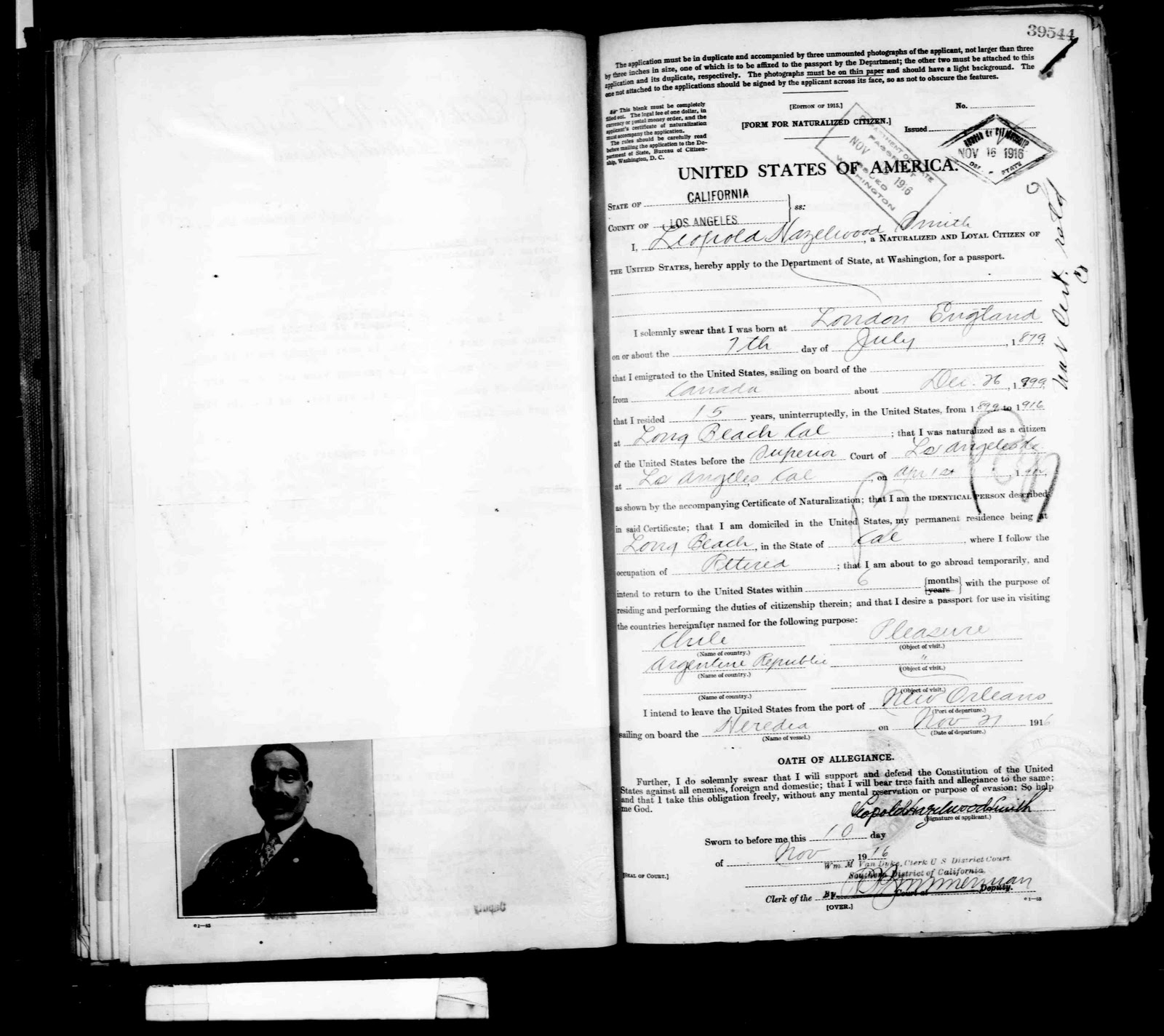
Here's a copy of Leo's passport application, with a photo:


Note that Percy also signed the application for Leo. (Also note that in old passports that had to describe things like their face shape (oval) and nose type (Roman). I didn't know there were different classifications for noses.)

Here are some photos Grammy sent of Percy's siblings. In the upper left is Leo with his wife Nellie. They lived in Tujunga, California for a time, and may have also lived in New Orleans (see the passport application above). In the upper right is a photo of Charles T Smith, who was the second oldest of the siblings. In the bottom left is Louis Smith (Leo and Louis must have been identical twins with those matching Roman noses). The photo on the bottom right is Lilian Beatrice T Smith and her husband, Percy Hallet. Percy was also born in England, where he and Lilian were married before moving to California. Together, Lilian and Percy Hallet had six children (I think). The first was born in England, and the rest were born in California.


Tuesday, April 27, 2010

John and Martha Mark

John and Martha Mark were my great-great-great-great-great grandparents. At Leslie's suggestion, I searched and found the following summary of these ancestors who were among the first pioneers on the Oregon Trail:

Most of the emigrants on the Oregon Trail were between the ages of 15 and 35. John Mark was a 52 year old veteran of the War of 1812, and his wife Martha was 50 when they set out for Oregon in the spring of 1847. They were the family elders, the nucleus of a small party of family and friends from Johnson County, Missouri, consisting of between 16 and 20 people in five wagons. Traveling with John and Martha were four of their children, aged 11 to 25. Two more Mark daughters, Mary Ann and Elizabeth, came along with their husbands, as did a group of neighbors from the Mulkey family.

The Mark party pulled out from the family homestead in Johnson County on May 2, 1847. They had their fair share of hardship and tragedy along the Oregon Trail -- Elizabeth lost her husband of six years, Jack Howard, during the journey. The location and cause of his demise are lost to us.

There was also cause for celebration in the group when Luvina Mark married a family friend traveling with the party, James Shirley, in a ceremony at Fort Laramie on June 20, 1847. The newlyweds marked the event by carving their initials in the bark of a tree growing along a nearby stream.

The party passed through the Whitman Mission at Waiilatpu shortly before the murders and kidnappings that put an end to the missionary era in Oregon. At The Dalles, they decided to pool their money and pay for passage over the Barlow Road rather than risk boating down the Columbia River. Like thousands of other overlanders, they inched their wagons down the infamous slopes of Laurel Hill by rope. On September 17, 1847, they reached the Trail's End in Oregon City.

Family lore has it that John Mark traded either a wagon or mare for a 643.39 acre claim in the Willamette Valley. It was claim number 63 on the books in Oregon City, making it one of the earliest land claims in Oregon. Mary Ann and Luvina took up neighboring land, claiming 640 acres with their husbands for each of their families. Elizabeth, who lost her husband on the Oregon Trail, remarried in September, 1848, and settled nearby. The area where they settled is known as Marks Prairie to the present day.

John Mark's eldest son, Alexander Kesterson Mark, was unmarried, and under Oregon's land laws he could claim only 320 acres. On his claim, which was part of the Marks Prairie neighborhood, he operated and dairy and planted an orchard of apple, peach, and pear trees. He drove his wagon to Oregon City regularly to sell cheese, butter, and, when the orchard came in, dried fruit. There are no records of any Mark family members joining the California Gold Rush when the news reach Oregon in 1848, but Alexander's butter and cheese no doubt brought in a tidy sum from merchants looking to the farms of Oregon to supply the miners.

However, Alexander was a religious man and lived frugally. When he built a large, two-story house -- a mansion for its day -- he did much of the work himself, even pitching in on the two-man whipsaw to help with the tedious job of sawing logs into planks. When his house was complete, he reserved a ground floor room for the use of local circuit riders, traveling preachers who rode regular routes through the countryside. In later years, the house became the focal point for the extended Mark family, and to this day a handful of the trees planted by Alexander Mark are still bearing fruit.


Source

Percy Hirst Grindrod Smith

Percy Hirst Grindrod Smith was born in Worthing, Sussex, England on April 9, 1881. Percy's parents were Thomas Smith and Eliza Sarah Gear. (Percy's father is erroneously listed in some places as Frederic John Smith. This is incorrect--Frederic was Percy's brother.) Percy was the sixth of seven children (whom we know about).

Percy's father, Thomas, was listed on census records as a surveyor and contractor. He was born in 1822 in Rickmansworth, Hertforshire, England.

Percy's mother, Eliza, died in 1895. For some time after, Percy lived with his aunt, Theresa Gear, who had never married and who had been living with Percy's family for many years. At the time of the 1901 England Census, Percy was living in London with Theresa, his older brother Louis, and little sister Lilian. Eventually, Percy left England for the United States, where he made his way to California.

In 1903, Theresa, Louis and Lilian came to America aboard a ship called the St. Paul. Louis, who was 23 at the time, listed his profession as "architect." They listed their final destination as Long Beach, California, where they possibly planned to meet with Percy, who had made the voyage in 1902.

At the time of the 1910 Census, Louis was living in Long Beach, California, with Aunt Theresa. By 1920, Louis and Theresa were living in Corona, California.

Percy was married to Bessie Flagg Losee on April 25, 1905, in Long Beach, California. For a copy of the LA Herald article that mentioned their wedding, click here. Percy became a successful real estate developer in the Long Beach area.

Percy and Bessie had three children for whom we have a record: Dorothy (born in September 1905), Walter (born in August 1907) and Winifred (born around 1915).

Percy passed away in Fullerton, California, on May 2, 1950.


Baptismal record of Percy and his siblings. Except for Lilian, who would be born later, all of the Smith children were baptized on September 8, 1881 in St. Marylebone, Middlesex, England.


Bessie and Percy Smith.


Mary Peer

As shown in the last post, Alice Flagg's mother was probably Mary Pier or Mary Peer.

I found Mary's information. Mary was born on January 29, 1820 to John and Elsha Peer. (John was John Peer, Sr., so the John Peer, Jr. at Mary's wedding was her brother.)

Here's the recording of the birth in the church registry in St. Armand Parish, Quebec: